Agentic Engineering Weekly for June 26 – July 4, 2026

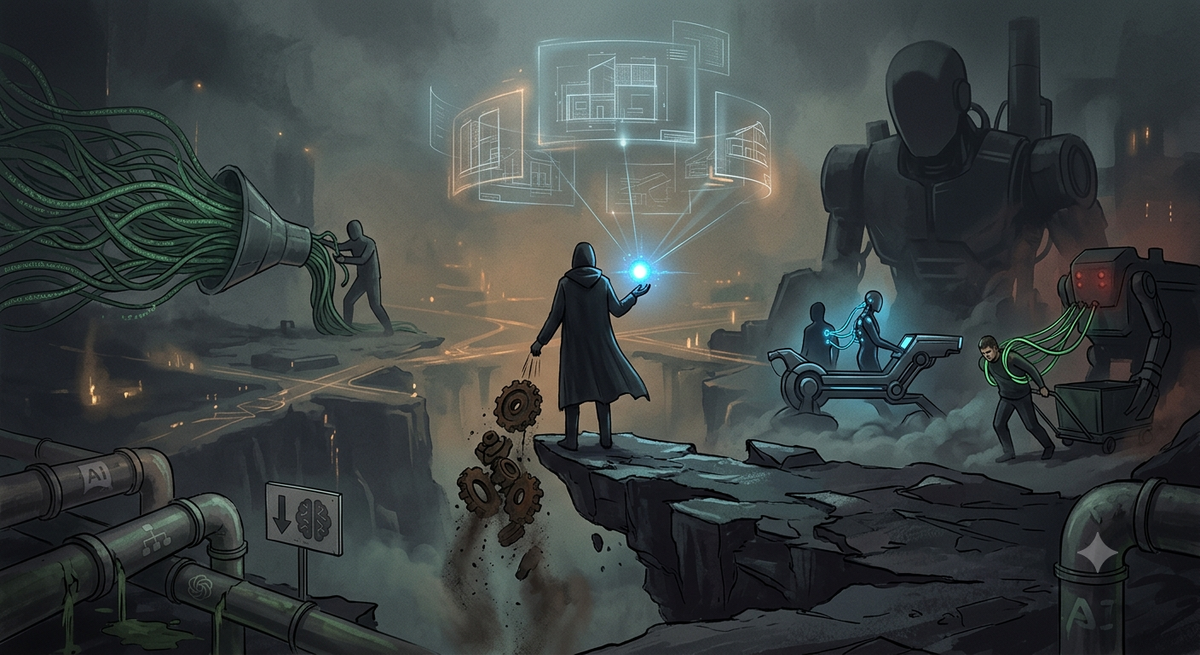
This week Kent Beck repriced some of his own skills at zero, Boris Cherny redrew the org chart and accidentally reinvented a twenty-year-old map, and Cory Doctorow asked the one question that cuts through every AI argument: who is the machine actually working for?
My top 4 picks this week
- Sustainable Augmented Development • Kent Beck • YOW! 2025: Kent has been a long-time influence on my professional career and is the reason I started taking agentic engineering seriously a year ago. When Kent speaks, I listen intently (video)
- Cory Doctorow: The Reverse Centaur's Guide to Life After AI 2026's "AI con", explaining why we ended up in this AI bubble and what to do about it. Your must-read for this summer. (book)
- Software Design in the Agentic Age: Place Your Bets: Matthias "DDD" Verraes' recap of the Thoughtworks "Future of Software Engineering" retreat (article)
- As Much Plan as I Can Actually Check: My colleague Felix wrote up how he scopes his specs and I can only nod my head in agreement (article)
This week's video
Personal AI assistants sound like something straight out of a sci-fi movie. Are they ready for prime-time or too good to be true? How expensive are they? Are they secure? In this week's video we set one up from scratch and try to hack it 🔓
This is a sponsored video. Build your own always-on AI assistant with Hostinger Managed Agent: http://hostinger.com/jovaneyck use code JOVANEYCK for 10% off.
Kent Beck's recalibration: 90% of my skills just dropped to $0
Kent Beck's YOW! talk is a must-watch for software engineers feeling anxious: "The value of 90% of my skills just dropped to $0. The leverage for the remaining 10% went up 1000x. I need to recalibrate." Coming from the creator of Extreme Programming, these statements hit differently than the usual influencer doom. The remaining 10% is worth naming precisely: teaching juniors, choosing what to pursue and what to leave alone, increasing optionality in your systems, and systems thinking, the value-stream-mapping kind that finds the constraints worth leveraging.
The talk's thesis is that we've all been thrust into a communal explore phase for how to build software with coding genies, and genies are disproportionately useful for exploration. Point them at expand or extract work and they need far more guardrails and steering. Kent shares a better title for the whole talk: "take your time". Resist the feature saw that generates just enough slack to get that next feature implemented, and instead invest in the compounding, incremental design, agentic harnesses and habitats until you hit escape velocity.
He makes another great point: junior engineers are a better investment than before, not a worse one. Their onboarding time has collapsed, and a fresh pair of untainted eyes is exactly what an industry-wide explore phase needs. Jessica Kerr sharpens the same point on Beck's podcast: AI did not replace programmers, it split the job in two. The hand-crafting half got commoditized like IKEA furniture. What's left is harder and more inherently human.
Worth reading:
- Sustainable Augmented Development • Kent Beck • YOW! 2025: The "90% of my skills" quote in full context, plus the features-vs-options curve that reframes what to do about it (video)
- S1E07: A Learning System Made of Learning Parts: Jessica Kerr's "the job split in two" framing is the most useful one-liner of the week (video)
- How Kent Beck shapes the software engineering industry: 147 minutes of Beck re-examining his own playbook with Gergely Orosz (video)
- Air Traffic Control: Beck and Keith Adams on the economics of the shift and why the moat may be gigawatts (article)
Boris's five archetypes are a rediscovery of Wardley's "explorers, villagers, town planners" metaphor
Boris Cherny looked at the Claude Code team, watched engineering, product, design and data science melt into a new kind of role, and named five archetypes: Prototyper, Builder, Sweeper, Grower, Maintainer. It's a genuinely useful observation. It's also Simon Wardley's Explorer, Villager, Town Planner, rediscovered from first principles. Beck's (yes, same Beck as above) 3X model (Explore, Expand, Extract) is the same map with different labels: different phases of evolution attract different aptitudes and different people who flourish in them.
The rediscovery matters because the original version comes with twenty years of accumulated warnings the new coinage lacks. Wardley's own write-up is literally titled "the dangerous path": naive implementations calcify into castes, and people get typecast instead of moving with the work.
If you only take one thing from this section: stop asking "what is the engineer's role now" as if there's a single answer. The bottleneck always moves, your place in your market does as well. The most important question is which stage of evolution your work sits in, and whether you have the people available who flourish there.
Worth reading:
- Boris Cherny's five archetypes: The tweet everyone will be quoting in job descriptions within a year (article)
- How to organise yourself: the dangerous path to Explorer, Villager and Town Planners: The original map, plus the failure modes the rediscoveries haven't hit yet (article)
- What Is Your Job Now, Farhan Thawar | Compile 26: Shopify's head of engineering on where the bottleneck moves when AI writes most of the code (video)
- The two kinds of engineers in the AI-coding era: The reductive two-box version, useful as a contrast to the five-box one (video)
The FOSE consensus: design moves up, understanding is the bottleneck
Thoughtworks gathered almost 70 people at its Future of Software Engineering retreat in Engelberg, and the write-ups converging out of it read like a coordinated position paper. Mathias Verraes states it as explicit bets: code quality still matters but is mostly automatable, high-level software design remains human territory, and specifications could replace code as the single source of truth. His hedge is the interesting part: build systems that can revert to human engineering if the AI bubble pops. The Syntasso write-up lands the same conclusion from the platform side: the organisations moving fastest are investing in better boundaries, not better prompts.
Geoffrey Litt supplies the constraint that makes all this urgent. Agents write code faster than humans can absorb it, so understanding is the new bottleneck, and understanding is worth exactly as much as it lets you keep participating. His techniques are refreshingly concrete: explainer docs, quizzes the agent writes for you, micro-worlds you can poke at. Simon Willison caught the same talk at AIE and named the failure mode as cognitive debt: your mental model drifting away from how the code actually works while the agent keeps shipping. Slow is smooth, and smooth is fast.
Worth reading:
- Software Design in the Agentic Age: Place Your Bets: The clearest set of falsifiable bets on where design goes, from someone who was in the room (article)
- Understanding is the new bottleneck: Concrete techniques for absorbing agent-written code, not just hand-wringing about it (article)
- AI Is Changing Software Engineering. The Fundamentals Still Matter.: The same retreat through a platform-engineering lens: boundaries beat prompts (article)
- What does code mean in 2026? — Thoughtworks Technology Podcast: When executable systems are generated from intent, the word "code" gets slippery (video)
Centaur or reverse centaur: who does the machine work for?
Cory Doctorow's fresh reverse-centaur book is the sharpest frame I've read for cutting through AI arguments: the most important thing about a technology isn't what it does, it's who it does it for and who it does it to. A centaur is a person assisted by a machine. A reverse centaur is a person conscripted into assisting one, the Amazon delivery driver kept in the van only for the last-mile parts the machine can't do, plus the accountability sink. His uncomfortable observation about our industry: the growth story investors are actually funding is a reverse-centaur story, because augmentation doesn't displace enough high-waged labor to justify the valuations.
I keep coming back to the personal version of that test. I get to use these tools as a centaur, and that's precisely why I appreciate them; many programmers will have the arrangement imposed the other way around. Alex Karp calling the AI industry "effing insane" in his heated Forbes interview, dissected at length by Primeagen this week, is what the reverse-centaur endgame sounds like said out loud. And the Luddite history is the corrective footnote: they were never anti-technology, they fought over who the machines were wielded for. Fight the salespeople's stories, not the looms. There is highly useful tech to be found today, but it's buried in growth stories designed to bamboozle investors and to keep those tech P/E ratios sky-high.
Worth reading:
- Cory Doctorow: The Reverse Centaur's Guide to Life After AI 2026's "AI con", explaining why we ended up in this AI bubble and what to do about it. Your must-read for this summer. (book)
- The World's Evilest Company: Primeagen reading the Karp interview so you don't have to, with commentary that earns the runtime (video)
- Understanding the Luddites in the age of AI: The actual history, which is about power over technology rather than fear of it (article)
- Honest Government Ad | Palantir: The satire version, which barely needs to exaggerate (video)
As much plan as you can actually check
Felix Fransen names a calibration rule the spec-driven crowd keeps missing: write only as much plan as you can personally verify. He writes specs before almost everything he lets an agent build, and still argues that heavyweight spec-first development runs backwards for early-career developers. A plan you can't check is a liability wearing a process costume: it produces confident-looking artifacts precisely where your ability to catch errors is weakest. The spec pays off when it separates code you can use from code you have to fight, and that payoff requires you to know the difference.
The same logic keeps surfacing under different names. Tracer bullets: small end-to-end slices you can verify early beat bloated solutions you audit late. Short leash: keep autonomy exactly as short as your ability to notice the dog dragging you. Addy Osmani's autonomy levels and Dan Shapiro's self-driving-car ladder both formalize it. The shared insight is that your verification capacity, not the agent's capability, sets the safe autonomy setting, and most people place themselves a level or two higher than they should.
Worth reading:
- As Much Plan as I Can Actually Check: The calibration rule stated plainly, especially relevant if you mentor juniors (article)
- Tracer Bullets: Keeping AI Slop Under Control: The Pragmatic Programmer's classic, usefully reloaded for agent workflows (article)
- Agentic Autonomy Levels: A working model for deciding how long the leash should be per task, not per team (article)
- The Best AI Coding Setup Isn't the Most Autonomous One (Here's Why): The five-levels framing that will tell you which level you're actually on (video)
Models became plumbing: Kimi in Copilot, grug speak, and discount frontier
Model releases now land like utility updates. A Moonshot model, Kimi K2.7, is generally available inside GitHub Copilot, which makes the multi-model marketplace a changelog entry rather than a roadmap slide. Sonnet 5 launched at near-Opus performance for 60% less, with a system card that openly explains the release strategy: deliberately weaker at cyber tasks so it clears the regulatory bar. Semgrep's benchmarks add the commodity data point: among models given nothing but a prompt, the best open-weight option beat Claude Opus 4.8. When open weights beat flagships on specific tasks, the moat has to live somewhere else.
The interesting differentiation is shifting to efficiency. Theo's dig into why OpenAI models score high on coding benchmarks while burning a fraction of the tokens (against Gemini's 250k-per-task average) points at the leaked reasoning traces written in compressed "grug speak". The models that think like cavemen are cheaper than the ones that monologue, and eloquent reasoning was never the point. If token bills are a line item you watch, tokens-per-task is becoming the benchmark that matters more than the leaderboard.
Worth reading:
- Why is OpenAI so much more efficient?: The grug-speak theory of model efficiency, the freshest angle on token economics this week (video)
- Kimi K2.7 Code is generally available in GitHub Copilot: Short changelog, big signal about where Microsoft's model marketplace is heading. The OpenAI marriage is officially over. (article)
Quick Hits
- Fable's judgement: The Claude Code team's tip: stop dictating how the model should work and let it decide when to test (article)
- Alibaba to ban employees from using Anthropic's coding tool: Geopolitics now flows through the developer toolchain in both directions (article)
- World's Biggest Experiment is Shutting Down: The LHC winds down to build something bigger, your non-tech wonder for the week (video)
Curated from 326 sources across articles, podcasts, and videos. Week of June 26 – July 4, 2026.