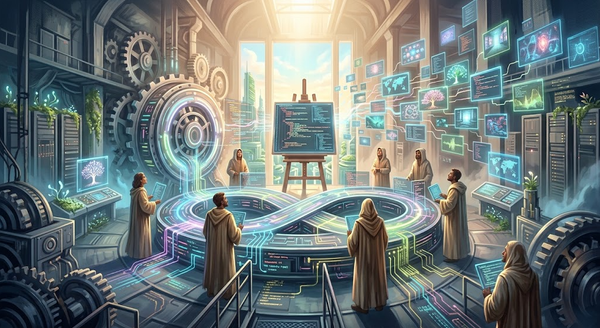
Agentic Engineering Weekly for June 6–13, 2026


This week the ground moved twice: Anthropic shipped its most capable model on Monday and a government directive switched it off by Friday. During that whiplash interest in Ralph loops resurfaced and two large datasets again called the AI productivity bluff. DDD Europe 2026 topped it off with a profound insight: "language matters", both for humans as for tools built from the entire world's writing.
My top 3 picks this week
- Loop Engineering: Stop babysitting your agents. Ralph makes a comeback (article)
- BREAKING: Fable and Mythos taken down: It only took Anthropic's latest model 4 days to go from limited release to international ban (video)
- Work Sucks: This piece covers the current software engineer sentiment well. (article)
Related video
Fable 5 shipped on Monday, the government switched it off on Friday
On June 9 Anthropic launched Claude Fable 5, a safeguarded, generally-available member of its Mythos-class family. Four days later the US government issued an export control directive citing national security, and Anthropic had to abruptly disable Fable 5 and Mythos 5 for every customer, including its own foreign-national employees. A frontier capability went from "generally available" to "revoked" in under a week. Lots of lessons to draw from here.
Simon Willison's verdict of Fable after the first hours was relentlessly proactive: it knows a great many tricks and will deploy any of them to reach a goal. That is exactly the trait that makes verification harder, because a system that always finds a path gives you fewer obvious places to push back. The more proactive the agent, the more deliberate your checks have to become.
Buried in the 319-page system card were interventions that silently degraded Claude's helpfulness on frontier-LLM-development requests, throttling you without telling you. Anthropic walked the policy back after the outcry. Stack the three together: a capable model, lack of transparency on guardrails and guardrail tweaks, wide access revoked overnight. The lesson: keep enough of your stack under your own control. No single vendor or directive should own your ability to ship.
Worth reading:
- Initial impressions of Claude Fable 5: The fastest credible hands-on review, with the "find a task it can't do" challenge (article)
- If Claude Fable stops helping you, you'll never know: The invisible-throttling detail everyone else missed in the system card (article)
- Statement on the directive to suspend access: The takedown in Anthropic's own words, worth reading as a dependency-risk case study (article)
- BREAKING: Fable and Mythos taken down: Fast walkthrough of the export controls with primary sources linked (video)
Loop Engineering: Ralph makes a come-back
loop engineering is replacing yourself as the person who prompts the agent. Prompt engineering, context engineering, harness engineering, habitat engineering, loop engineering. Things might feel like they're moving really fast, but that's an illusion due to semantic diffusion and people discovering insights in parallel, coined under different names. "Loop engineering" has been out in the field for a year now, the only difference is that most of the tools now support it out of the box. Just another useful skill for the agentic engineer toolbox.
Design the harness & cultivate the habitat. Pull the important decisions out of the agentic loop.
The industry's favourite phrase, "human in the loop," implies the AI is driving and you are there to catch its mistakes. That's backwards. Humans should be in the lead instead. Loop engineering pushes you to automate yourself out of the loop, while good judgement pulls you to stay at its head. The loop is just another context management technique.
Worth reading:
- Ralph Wiggum as a "software engineer": The OG loop engineering article (article)
- Loop Engineering: The post that named the week's concept, source material for the whole thread (article)
- How to Keep Shipping When You Walk Away from Your Desk: The most concrete loop in practice, voice-to-worktree-to-walk-away (video)
- What it takes to keep humans in the lead with AI: The sharpest counter, flips "in the loop" to "in the lead" (article)
The productivity whiplash
Two more large AI productivity datasets arrived and pointed the same way. Faros AI's 2026 report drew on telemetry from 22,000 developers and named the pattern AI acceleration whiplash: output climbs, then the gains stall or reverse downstream where review, integration, and rework live. Goldratt comes calling. LeadDev covered a separate study of more than 100,000 developers with a blunter headline: AI is making developers busier, not more productive. Busier and faster are not the same thing.
The mechanism is familiar to anyone who has watched a review queue back up: you can generate ten times the code, but you have not scaled your ability to verify, integrate, and own it. The Weave data, from tens of thousands of engineers, shows the top 1% automate the whole assembly line around coding rather than just the typing. Amdahl's Law explains why that matters: coding is only a fraction of the job, so optimising only that step caps (or even decreases) your total speedup no matter how good the models get. If you're not working on the bottleneck you're not improving anything.
Worth reading:
- The AI Acceleration Whiplash: Ten Takeaways: Two years of telemetry from 22,000 developers, hard numbers to argue with (article)
- AI isn't making developers more productive, it's making them busier: A 100,000-developer study that complicates the productivity story (article)
- What the Top 1% of Engineering Teams Do Differently: Real data on what the best teams automate, beyond the 400x LinkedIn hype (video)
Naming and language matters more than ever
The ClassEval-Obf paper, "When Names Disappear," strips human-interpretable identifiers from code and watches model performance collapse, not just on summarization but on coding tasks that should depend only on structure. When a machine that's trained on human language "understands" your intent largely through names and concepts, sloppy naming is no longer a style nit. It is a comprehension bug you are shipping to your most literal-minded collaborators.
This was also one of the biggest themes from DDD Europe 2026. The through-line across talk after talk was that deliberate language matters now more than ever, and that the ubiquitous language has become part of the habitat we engineer for agents and humans alike. Domain-driven design spent two decades arguing that shared vocabulary and mental models is how humans align on meaning. The paper above is the empirical other half: the same vocabulary is how agents recover intent from structure. Do yourself a favour and invest in your communication skills. Read, write, talk to people.
The naming discipline good domain modellers already practise is no longer just a human-alignment prerequisite. It is becoming a machine-readable asset, and the teams who treat ubiquitous language as a deliberate asset and part of the habitat rather than noisy documentation will get more reliable agents.
Worth reading:
- When Names Disappear: What LLMs Actually Understand About Code: Hard evidence that naming, not just structure, drives model comprehension (article)
Stop counting tokens, start counting value
Last week's story was companies capping token budgets. This week the smarter critique landed: decide what the tokens are supposed to find or deliver, then measure that. Cost is the wrong denominator: optimise for cheapness and you get cheapness, optimise for what shipped and you get throughput. The Pragmatic Engineer confirmed the trend this pushes against, with leaders dampening spend through per-engineer budgets and model routing.
Both OpenAI and Anthropic filed to go public, which Ed Zitron reads as a race for exit liquidity by companies burning billions with no clear path to profit. You do not have to share his bearishness to take the practical point: the economics are unstable, the teams that thrive will be the ones who can articulate value per token rather than just defend their bill. McSweeney's "AI Economics for Dummies" captures the circular-financing absurdity more memorably than most analyst notes, and it is a faster read.
Worth reading:
- Before You Build a Token Economics Dashboard, Build a Value Dashboard: The reframe that turns a cost-control reflex into a value question (article)
- The Pulse: cutting back on AI spend within eng departments: Field evidence of how leaders are actually dampening spend (article)
- AI Economics for Dummies: Satire that explains the circular financing better than the analysts (article)
Agent experience is the new developer experience, and it's a perfect circle
A cluster of talks converged on one structural claim: the thing you now design is the agent's environment, not the prompt. Developer experience is giving way to agent experience, built from context, deterministic environments, verification, and safety. Or as Laura Tacho puts it: "The Venn Diagram of Developer Experience and Agent Experience is a circle"
For anyone with an XP background this is comfortable territory wearing new clothes. The spec, the tests, the environment, and the feedback loop were always the product, and agents just made it impossible to pretend otherwise. Don Syme's talk on adding Continuous AI to CI and CD, with agentic workflows that scout ahead and clean up behind, is the natural endpoint that ties multiple of this week's thread together: the repo becomes a place agents inhabit continuously, not a thing you point them at occasionally. The teams investing in habitats now are building the surface every future agent will run on.
Worth reading:
- Agent experience is the new developer experience: The clearest statement of the AX-over-DX shift (article)
- Harness engineering beyond code (Marc Sloan): Extends the harness into product and design context, not just the codebase (video)
- Living Specs vs Static Specs: Why bidirectional specs beat static ones on multi-step agent tasks (article)
Quick Hits
- Reflecting on a year of Claude Code: Boris Cherny and Cat Wu on what one year of agentic coding actually changed (video)
- Cleaning up after AI rockstar developers: The rockstar-leftovers pattern, now a preview of AI-generated maintenance load (article)
- Are You Too Busy to Think?: Cal Newport's case for the pause, a counterweight to busier-not-faster (video)
Curated from 5 sources across articles, podcasts, and videos. Week of June 6–13, 2026.