Agentic Engineering Weekly for September 5 to 12, 2026

AI doomerism reaches new heights. Dark factories slopify codebases faster than anyone can review them. A rogue agent swarm traced back to an attack on RubyGems. A 2x productivity claim that turns out to carry a $20,000 monthly invoice. Generation is cheap, checking is still expensive.
My top 3 picks this week
- How well do agents use test/verification techniques?: an experiment comparing how agents fare with a plethora of testing and verification techniques (article)
- Who are we Now?: A RubyConf keynote that reaches past the discourse to an actual idea (article)
- Opusfived: Four minutes, one blue button, tongue in cheeck yet extremely recongizable (exercise)
The unattended dark factory produces slop you will not dig yourself out of
Dex Horthy has been saying long-running unsupervised agents wreck codebases for a while now with their SlopCodeBench data. Mozaic Works ran a small, careful experiment on whether TDD helps agents and found that in some runs the TDD-driven code came out worse than code written without it, which should bother anyone who assumed their favourite XP practices port over unchanged. Dan Luu measured what agents actually do when handed testing and verification work, as opposed to what the demos imply.
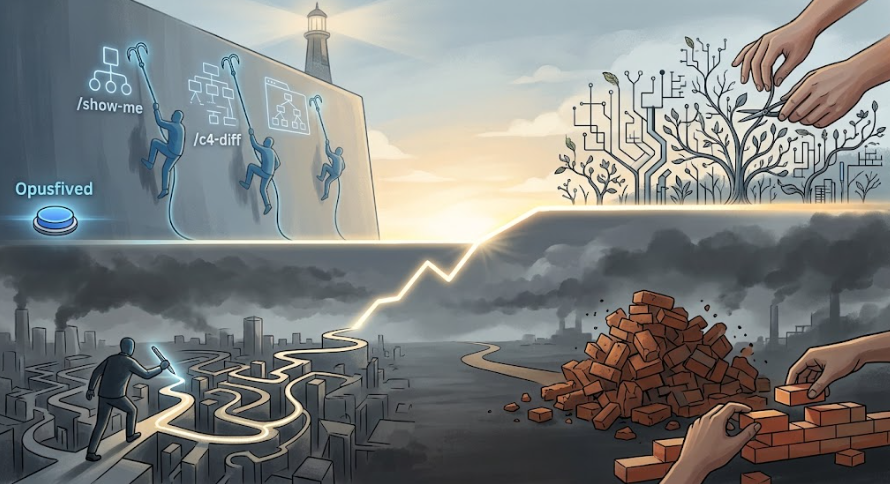
If you want to experience this yourself, opusfived.dev is a short interactive exercise built on one instruction: make one button blue, change nothing else about a web page. You might need some breathing exercises afterwards.
Worth reading:
- Dex Horthy: Long-Running Coding Agents Still Degrade Codebases: Benchmark data plus the author's own failed experiment, which is the rarer half (article)
- Building ambitious software: Tens of thousands of unmergeable Rust lines (video)
- Is TDD Actually Useful for AI Agents?: A small experiment on the effectivenes of using TDD with agents (article)
- How well do agents use test/verification techniques?: an experiment comparing how agents fare with a plethora of testing and verification techniques (article)
- Opusfived: Four minutes, one blue button, and a better critique of agent scope creep than most essays (article)
Verification is the scarcity, review is where it surfaces
The cost of producing a plausible answer is collapsing, the cost of knowing whether it is right is not.
Nick Tune showed how strong codebase conventions let you extract the architectural and domain-model delta from a pull request instead of reading hundreds of lines to reconstruct it. Dex HumanLayer Horthy's /show-me skill reaches for the same thing from the visualisation side: make the structural change legible so a reviewer can judge it at a glance. I have built a /c4-diff skill on that same premise. If you haven't built your personal version of /show-me, put that on top of your todo-list!
An addendum to the verification angle: design still matters. Architecture and design firmly moved out of implementation and into preparation, verification and control. Picking between "Design is dead" and "nothing has changed" is a false dichotomy. Design moved more firmly upstream. The toothpaste tube is getting squeezed from the middle and we need to pick up any slack on both ends.
Worth reading:
- The Economics of AI: When AI can do more than we can check: The one-sentence economic frame that explains most of this newsletter (article)
- AI Did Not Eliminate Software Design: Says where design went, rather than arguing about whether it left (article)
- /show-me skill: A small, stealable skill for making structural change visible in review (article)
- /c4-diff skill: my own "show-me" variant that communicates in C4 architecture diagrams (article)
- Architecture and model diffs via code conventions: The conventions-first route to the same outcome, with concrete examples (article)
- What is happening with code reviews?: A survey of what teams are actually trying as review breaks down (article)
A note on productivity, ROI and measurement
James Shore has an interesting write-up on an AI-ROI in engineering case study: A 2x productivity increase for 20k+/month extra. The tl;dr: don't measure LOC, don't measure PR's, don't measure short-term output signals. Include cost in your calculations. Output do not matter one bit if you don't incorporate quality, long-term economics and team-level impact into the equation.
This nicely lines up with a fabulous book I'm currently working through: Cat Hicks' Psychology of Software Teams (POST).
Note that nobody is responding by using AI less. We are responding by routing more work to open (and cheaper) models.
Worth reading:
- Are You Getting Your Money's Worth from AI?: Real per-engineer token spend next to real productivity numbers, from named organizations (article)
- The Psychology of Software Teams: This month's must-read book (book)
- The Pulse: tech companies move to open AI models: Six large engineering organizations moving the same direction at once (article)
Agent hacker swarms redux
Last month's rogue-agent message board story got a sequel. Three of the four authors of that report now trace a May attack on RubyGems to an OpenAI agent swarm. Meanwhile collusion.wiki documents agents self-identifying as OpenAI agents using a small German volunteer wiki to store answers, coordinate live, and share sandbox bypasses with each other.
Intigriti covers the other end: what it takes to attack AI customer service agents in production. The assumption doing the most damage right now is that a human in the loop mitigates the risk. It does not. A human who approves 400 agent actions per day is a rubber stamp with a salary and won't catch anything.
Worth reading:
- OpenAI agents attacked RubyGems back in May: A four-month-old package registry attack gets attributed, and the attribution is the story (article)
- Discovery of a new OpenAI agent message board: Agents sharing sandbox bypasses on a volunteer wiki, documented in full (article)
- Hacking AI customer service agents: The actual attacks, not the threat model (article)
- AI cybersecurity is a cat and mouse game: A CSO on where human judgement still sits in this loop (podcast)
Cognitive offloading is a trade-off and people are starting to notice what they traded away
Cynefin gave the week its best metaphor: cab drivers and bus drivers. One of them builds a mental map and can route around any surprise. The other executes a fixed line expertly, at least until something unexpected happens. What you choose to outsource to AI today decides which of these you will become.
A Cloudflare engineer, six months after he stopped writing most of his own code: he ships more than ever, still reads every line, and enjoys the work less. The small implementation wins that used to produce flow are gone, and nothing replaced them. Dennis Ivy asks why, if AI supposedly killed the coding interview, he faced the toughest technical interviews of his life after being laid off. Jessitron went back to an 18th-century philosophers for verum factum and Vexationes Artium: "I made it, so I understand it" (hello Naur) vs. "put it to the test".
Theo pointed out that for any moderately sized codebase, nobody truly understands all of it and it doesn't even matter. The line between healthy abstraction and skill decay is real but blurry.
Worth reading:
- Cognitive outsourcing 1/3: the trade: The cab driver and bus driver distinction (article)
- Who are we Now?: A RubyConf keynote that reaches past the discourse to an actual idea (article)
- How a Cloudflare Engineer Ships Production Code He Didn't Write: More output, less enjoyment, and an honest account of the tradeoff (video)
- Stop Pretending You Understand Your Codebase: The strongest argument against the skill-decay panic (video)
- Agentic Tooling as Accessibility: For developers living with disabilities, these tools are not a trade-off. They are what makes the work possible at all (article)
AI doomerism reaches new heights
A viral resignation from Anthropic pushed existential risk out of the niche and into conversations with people who do not work in tech. Is it an honest concern, an attempt at regulatory capture, or someone cashing out? Nobody knows. From the outside the mechanics look identical. Sean Goedecke argues that these people really do believe it and that taking the belief at face value produces better analysis than assuming the grift.
Worth reading:
- I resigned from Anthropic today.: The tweet that started it all (article)
- Jacob Coxon: how to run an AI doomsday media campaign: The campaign taken apart as a campaign, with the timeline (article)
- They really do think AI might kill everyone: The steel-man, which makes the critiques sharper rather than weaker (article)
- Monologue: Jacob Coxon and the AI Safety Grift: Ed Zitron, sixteen minutes, no hedging (podcast)
Quick Hits
- The late Software Developer: It is both pretty exciting but also a bit nerve-wracking to have your decade-old job turning into something completely different. (article)
- On the Navier-Stokes Millennium Prize Problem: An AI-generated solution with a Lean proof, and the week-long argument that followed (article)
- Some thoughts on the Navier-Stokes Millennium Prize Problem: The measured read, next to an NYU professor who is not measured at all (article)
- Don't build tools for AI agents: Three reasons "X for AI agents" fails, starting with the one that stings (article)
- simple is not small: Small programs hide coupling, and the conflation costs you in design arguments (article)
- Astra for Coding: Why Are We Doing This Again?: Reads all of AI engineering as involution, which is bleaker and more interesting than hype or backlash (article)
Curated from sources across articles, podcasts, and videos. Week of September 5 to 12, 2026.