Agentic Engineering Weekly for September 18-27, 2026


The question moved this week. Nobody serious is still asking whether agents can write the code: the people shipping the most are asking who verifies it, how cheaply, and how to move humans on top of the loop instead of stuck inside it. Meanwhile two new frontier models dropped and DHH declared hand coding over to the rails community.
My top 3 picks this week
- poteto's software factory: The clearest real-world demo of evidence-first agentic engineering I've seen this year. Best 30 minutes you'll spend this week (video)
- "It's called etiquette, and we don't have it yet.": Two thoughtful practitioners admitting they're lost too, which is oddly reassuring (video)
- Rails World 2026 Opening Keynote - DHH: The portrait painters metaphor alone is worth the watch (video)
Autonomous verification is the ladder from in-the-loop to on-the-loop
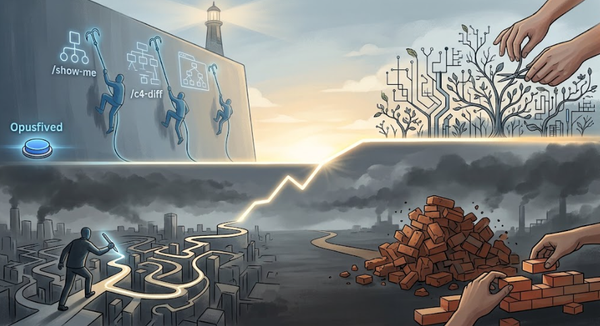
If you watch one thing this week, make it Lauren "poteto" Tan's walkthrough of their software factory. It's the best 30 minutes you'll spend, and it mirrors my own agentic engineering process almost one to one. Poteto ships around 2,000 pull requests a month. What makes that possible is autonomous verification: the factory doesn't just produce code, it produces evidence that the code works. That evidence is what lets you climb from in the loop, approving every step, to on the loop, supervising a system that checks itself and only intervening at high-leverage points.
My own rule of thumb after two years of building software with agents: the quality bar for code that first meets human eyes should be extremely high. It's always worth spending extra tokens on higher-quality code and on evidence that's easier for human eyeballs to digest than reams of raw code diffs. Tokens are cheap and getting cheaper every quarter. Human attention is the scarcest resource in any software factory, so that's the thing to optimize for. Matt Pocock made much the same point on the AI Engineer Paris main stage, and the Claude Code team published a video on giving the agent more ways to check its own work so it needs fewer round trips with you.
From the other side of the court we have Dan Luu reminding us there's no point at which turning your brain off works: a Bazel migration still took months with agents because of the constant stream of decisions and unknown unknowns. And Simon Willison is increasingly convinced agents make software engineering harder, because unlocking them takes extraordinary discipline. Verification loops move the engineer to where the leverage is.
Worth reading:
- Poteto's factory: The clearest real-world demo of evidence-first agentic engineering I've seen this year (video)
- AI Engineer Paris 2026, Matt Pocock segment: Same conclusion reached independently on a main stage (video)
- Building verification loops in Claude Code: Tests and linters are the floor, here's how to raise it (video)
- There's no point at which turning your brain off will work: Your weekly reminder to find your alpha. Don't become a meat proxy. (article)
- Dexter Horthy: Why We Stopped Trusting AI to Write the Plan: A team whose bet on spec-driven development nearly wrecked their own codebase, and what they review now (podcast)
The kernel of a coding agent is a while loop, and the KV cache is the real architecture
The team behind Jev, the "System One" decision model that came out of stealth last week, published their rough thinking on what a typesafe coding agent would look like. Their starting assumption is refreshingly blunt: coding agents are surprisingly simple. A while loop and a handful of tools. How would you design a coding agent if LLMs had no KV cache?
That question exposes a list of design choices we take for granted that only make sense because of cache economics. Take routing easy work from Opus to Sonnet and back: their napkin math puts pure Opus at roughly two thirds of the cost, because the big model has to re-read the whole context when control returns. Compaction assumes every future turn wants one shared state. Tool definitions eat the system prompt whether they're relevant or not. Subagents struggle less with the work than with deciding which context to hand over and which to merge back.
Their proposed direction: score every chunk of context for relevance per query (hide it, summarize it, or show it in full), load parts of AGENTS.md conditionally, and share explicit read-only state between background agents such as cross-model reviewers. Whether or not Jev is the vehicle, I find it a useful lens for anyone building a harness. The ecosystem around decision models is maturing fast: Sean Goedecke points out a general-purpose classifier can label the data to train its own narrow replacement.
Worth reading:
- Thoughts on a typesafe coding agent: "The tyranny of the KV cache" is the most useful frame for harness design I've read in a while (article)
- Jev introduces a new shape of LLM: Simon's hands-on take, and why "decision models" is the better name (article)
- System One models like Jev can train their own replacements: The second-order effect nobody at launch talked about (article)
- Can Jev Be a Better Agent Evaluator?: Jev-as-a-judge benchmarked against LLM judges on accuracy, repeatability, latency and cost (article)
- It's impossible for Jev to be good: Good old Mo providing the skeptic's POV, so you're not only hearing the fans (video)
Nobody is caught up anymore: we each live in a our own private version of the future
Jessitron and Avdi opened the latest Machines of Code and Grace with a confession: nobody, themselves included, is ever fully caught up on the AI news cycle. I think that's a gross understatement for 99% of software engineers out there. Things move so fast that we are all living in our own private version of a possible future. Your team's idea of "how software gets built in 2026" is a fork, and so is mine, and neither of us has seen all other's.
You can see the forks everywhere. Less Bitter talked to 50 people 1:1 about how they code with AI and summarized the result in four words: it's a mess. Simon Willison quoted someone two weeks into a big-company job where the specs, code, tests, tickets and reports are all generated by Claude Code, and nobody on the team likes it. Sean Goedecke opens his advice for beginners by telling them to distrust engineers giving advice, because nobody really knows anything right now.
What's missing is the thing that normally syncs a community: shared norms, or as Jessitron puts it, "etiquette". Charity Majors and Cat Hicks started a dialogue on where AI norms even come from. One of lmy favorite conferences, XP Days Benelux, announced it won't return. One of the places where our craft used to compare notes is gone right when we need it most. Go find your people and compare notes people, I'll be doing exactly that at next month's Socrates BE unconference.
Worth reading:
- "It's called etiquette, and we don't have it yet.": Two thoughtful practitioners admitting they're lost too, which is oddly reassuring (video)
- I talked to 50 people building with AI. It's a mess.: 50 interviews beat 50 hot takes (video)
- Where do AI norms come from?: Charity Majors' view on how communities form norms, applied to us (article)
- RIP XPDays Benelux - Long live XP: A small obituary that says a lot about where the craft community stands (article)
The craftspeople are calling hand coding over, and the dissent is getting sharper
DHH gave the Ruby community its "hand coding is dead" moment at Rails World. His company 37signals has gone "pencils down" on handwritten code. DHH calls writing code by hand chiseling, and compares it to portrait painters when photography arrived: the good ones didn't stop making art, they moved on to other forms of creativity. Coming from the person who spent two decades defending programmer happiness and the joy of beautiful code, that lands differently than yet another founder tweet. Now, DHH and I disagree on a lot of things, but on this point we agree vehemently.
DHH isn't alone. Emily Bache wrote that a single year of AI overturned what 20 years of TDD practice had taught. Felienne Hermans told DDD Europe that AI made her doubt everything about programming. Angie Jones: we're system designers now. Tom Tunguz sums it up: AI removed the typing and left the system design.
The dissent is getting louder too. Alexandru Nedelcu argues that people who stop reading and writing code lose the wisdom that comes with it. Lars Faye points out agentic coding is barely a year old and the industry leaves no room for nuance. I'd frame it as a false dichotomy: keep the chisel as a tool you pick up deliberately to learn and to verify, but you have stop treating it as the default way you produce code.
Worth reading:
- Rails World 2026 Opening Keynote - DHH: The portrait painters metaphor alone is worth the watch (video)
- The Last Year Has Changed Everything I Knew About TDD After 20 Years: A TDD veteran re-deriving what the practice is for (article)
- Thinking in Systems, Shipping in Loops: Donella Meadows applied to agent loops, with real throughput numbers (article)
- AI Has No Wisdom and Neither Will You: The strongest version of the counter-argument this week (article)
Opus 5.5 and GPT-6: stop telling the model to think harder, start telling it where the finish line is
Two frontier releases landed within an hour of each other: Anthropic's Claude Opus 5.5 and OpenAI's GPT-6 Sol and Luna. Prices halved again. Epoch AI puts the trend in context: the cost of a given level of AI performance falls about 13x per year, faster than electricity, compute or DNA sequencing ever did.
The more practical news is how your prompting should change. According to Anthropic's own guide, Opus 5.5 always thinks before replying, so your "think carefully" lines are dead weight. Hand it the complete task in one message with a clear finish line instead of drip-feeding guidance. Give your agents stop and continue rules upfront so long runs don't need your babysitting. Keep task lists out of the context window so they survive compaction. Ask it to mark explicitly what it couldn't confirm, and read the "needs from you" section first when a long run ends.
Reasoning effort is now a dial you set per task rather than a model you pick, which is exactly what Sebastian Raschka's deep dive on low, medium and high effort modes explains. One caveat from Simon Willison's testing: Opus 5.5 at "max" effort blew past the 128k output limit on some prompts. More thinking is not free, even when the reasoning tokens are cheap.
Worth reading:
- Getting the most out of Opus 5.5: The vendor's own list of habits to drop, straight from the source (article)
- Claude Opus 5.5, GPT-6 Sol, GPT-6 Luna, and a new price war: All the prices in one place, plus the max-effort gotcha (article)
- Controlling Reasoning Effort in LLMs: How models actually learn effort modes, so the dial stops being magic (article)
- The plunging price of thought: 47% cheaper per quarter, measured across five benchmarks (article)
- Please stop using stupid models: The best models win by doing the dumb things right more often (video)
At 50 deploys a day, the pull request is the next thing to go
Amp ships to production around 50 times a day with agents. Dario Hamidi credits their speed to letting go of pull requests rather than to AI, which Dario argues are holding most teams back. That fits a pattern we saw last week. Once agents write the change, every queue downstream of the diff becomes the bottleneck.
Linear's CI write-up shows what standing still costs. Their test suite nearly quadrupled since January. They switched to the native TypeScript compiler, moved to faster runners, doubled their test shards and consolidated seven checks into two, saving 87,000 runner-minutes per month. The payoff? PR wait time went from just over six minutes to just over five. That's the Red Queen effect surfacing in our deployment pipelines: running as fast as you can just to stay in the same place.
Worth reading:
- How Amp Ships 50 Times a Day With AI Agents: A team arguing for killing the PR, with the numbers to back it up (video)
- AI coding has made CI a bottleneck, so we reworked ours to keep up: Four concrete CI changes you can steal on Monday (article)
- What product looks like when coding is solved: The bottleneck hunt, extended beyond engineering. Goldratt in action. (video)
- Measuring AI's Unintended Consequences: How to measure what the speed metrics hide (article)
The software factory is now a vendor category
A month ago a software factory was something you hand-built from blog posts. Today we have our pick between "build your own software factory" offerings. When vendors start packaging a pattern, the primitives are commoditizing: work queues, sandboxes, agentic identities, review loops, evidence packages.
That shifts where the value lies. There is no single best factory layout, and I'd be suspicious of any vendor claiming theirs is it. The winners will be teams that shape a factory to their own context, measure it and keep improving it. Steve Yegge's report from running around 50 agents on his game Wyvern is the useful counterweight to the demos: the breakdowns are as instructive as the breakthroughs. Matt Pocock warns that most companies aren't organizationally ready for background agents yet, however good the tooling gets. That was my exact closing quote during my last talk on software factories as well: it's obvious this is the direction where things are going, but none of my clients are ready for it just yet.
Worth reading:
- Inside Steve Yegge's Software Factory: Lessons from Running 50 Agents: Field notes from the most aggressive factory operator out there (video)
- The AI factory playbook for engineering teams: Warp's CEO on the factory as a platform product (video)
- Most companies are NOT READY for background agents: The organizational prerequisites the vendor demos skip (video)
- pstack: How The SpaceX Team Actually Runs Grok Bot: Usage exploded outside engineering within hours, and coding had to wait (video)
Quick Hits
- The Rise of the Forward Deployed Engineer: The engineer who built Palantir's FDE program explains how to do the job right (article)
- Fragments: September 24: Fowler via Rob Bowley argues the real AI risk is wiring it into everything, not a rogue superintelligence (article)
- Defend your downtime to improve agentic output: Stop filling the agent's build time with another tab, that pause is where your thinking happens (article)
- the senior engineer death spiral: On proving yourself, burning out, and being a good teammate anyway (article)
- AI is not "just a tool": Why the most common framing is also the most irresponsible one (article)
- How Would You Type-Check 30 Million Lines of PHP?: The origin story of Hack, a masterclass in incremental migration (podcast)
- The Vampire Problem: Why some choices can only be understood after you make them (article)