Agentic Engineering Weekly for September 12-19, 2026


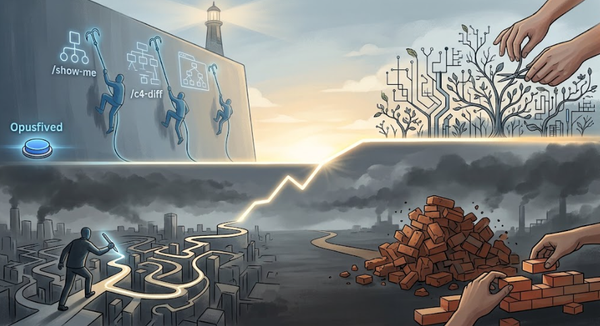
A stealth lab refreshes interest in narrow AI. Agentic coding keeps stressing CI platform infrastructure. The shape of the software factory is converging. Fundamentals matter more than ever. Pacing the frontier is a diversion tactic.
My top 3 picks this week
- Jev explained in 7min..: Great explainer video on the newly released "Jev" model (video)
- Report – AI and Education (MIT): MIT is raising the alarm on AI use in teaching and learning (article)
- AI Skills with Matt Pocock: The person who wrote the most-used skill explaining why fundamentals are the thing that makes skills work (video)
A new model "Jev" returns structured decisions instead of text and that reopens a design space
TypeSafe AI came out of stealth with Jev, a model that does one thing and does it both fast and cheap. You hand it a set of multiple-choice questions and it hands back typed decisions with calibrated probabilities, in a fraction of the cost and speed a typical LLM would require. As a chatbot it is useless. As a component inside your own code or harnesses it is something we have not had before: intelligence cheap enough and fast enough to wire inside a hot loop.
Dubbed a "System One" model (a metaphorical nod to Kahneman's System I & System II), it's designed to operate as a fast, low-cost decision-making component within larger systems, rather than as a standalone conversational agent.
The coverage has mostly fixated on the 200x speed claim, which I find is the least interesting part. The interesting question is what kinds of workloads we can restate as a handful of classifier tasks. I'm guessing this will be a big deal for AI engineers and harness builders alike. Anything you Jev can do, an LLM can do as well. The staggering difference in speed and cost is what makes the difference.
Optimizing for human preference optimizes for engagement and overpromising. RLHF-built LLM's are extraordinarily good at pleasing the human in the loop, which is the wrong objective when the consumer is a switch statement in code.
Worth reading:
- Jev explained in 7min..: Great explainer video on the newly released "Jev" model (video)
- What Is Jev? A Guide to TypeSafe AI's System One Model: Shows where a System One model actually slots into an agent loop, which is the part the launch coverage skipped (article)
- Two techniques for working with System One models: The practical decomposition question, including when the decomposition costs more than it saves (article)
- Why Jev — Diogo Almeida, TypeSafe AI: The GPT-4 co-inventor that has now come up with Jev arguing that RLHF optimized for the wrong thing (video)
Several benchmarks shift focus from model in isolation to model + harness
For two years the question that's being repeated ad nauseam has been "which model is best". HarnessTax unasks the question. The team evaluated 21 model-harness pairs across seven models and three harnesses (Claude Code, Codex CLI and Pi) on SWE-bench Lite and Terminal-Bench 2.0. The results: your beloved Claude models may not need Claude Code.
There is a shelf-life problem lurking underneath all of this rapid evolution: Uncle Bob's states that most of his harness has already been obviated. Build today's skill/harness/factories but expect to deprecate them at the next model release. That sounds wasteful until you consider the alternative: a harness tuned for last year's failure modes fights a model that no longer has any of them.
Worth reading:
- HarnessTax: How Much Does the Harness Matter for Coding Agents?: 21 model-harness pairs, and the finding that model and harness should not necessarily match brands (article)
- Real-SWE Benchmark: Private production codebases licensed from real companies, so contamination is not doing the work (article)
- Fragments: September 16: Fowler on super-persistent rather than super-intelligent, and on harnesses aging out (article)
- Feedback Loop Engineering: Inner, middle and outer loops as a vocabulary for the work HarnessTax is now pricing (article)
Agent throughput broke review first, CI is next
Anthropic's own CI job volume went up by a staggering 25x in six months. Build and test speeds everywhere are optimized for human speed. Agents do not sleep.
When the constraint on shipping moves from writing the change to verifying it, every queue downstream of the diff becomes the bottleneck. CI, review, staging, rollout, all of them. Management dreams of turning the lights off entirely, while engineers on complex legacy dim them instead. Don't go dark y'all, every factory needs some lights.
Sean Goedecke argues that developer experience measured in seconds is about to matter again. Sub-second feedback used to be pointless because humans needed a couple of seconds to do some actual thinking anyway. In today's world every millisecond is back on the critical path. Zed is betting further out with Delta, which drops the pull request as the review unit entirely. And Steve Yegge ties the economics together: Distrust is what costs money, and trust is the only thing that buys it back. Trust is incredibly hard to win back once it is (so easily) broken.
My fix for all this? I think a lot of companies could benefit from revisiting their test automation strategy. For a typical app or small-to-mid-scaled service, your full CI should run in under 5 minutes. Interested in how to get there? Hexagons are the bestagons, parallellize and virtualize ruthlessly. Or give me a call, I do this stuff for a living!
Worth reading:
- Agentic coding is straining CI: 25x volume, three failed patches before a fix that held. Numbers, not vibes (article)
- AI Changed How Spotify Builds: The surprise is what was not on their list of four problems (article)
- Seats and Sunsets: Yegge reduces three separate factory failures to one economic claim about trust (article)
- Gray Factory: Code Review for Agentic Engineers: Dimming the lights instead of turning them off, from someone working in real legacy (video)
- Slow developer experience will bottleneck fast models: Makes the case that millisecond dev-loop work is about to stop being premature optimization (article)
The shape of the factory is converging
The Pragmatic Engineer deepdive on how Codex took over engineering inside OpenAI is the most detailed look yet at a frontier lab running its own software factory. The novelty is not what strikes me, though. It is how closely the whole thing rhymes with what Stripe, Zalando and Ramp and many others have published over the past month. Isolate the work, treat it as a first-class citizen, build it, prove it, ship it.
I have been pulling these published factories apart into their moving parts, and the same primitives keep showing up.
The adoption question is where the debate hasn't settled yet. Warp's Zach Lloyd argues first crawl, then walk, finally run. Addy Osmani makes the point that matters most for anyone reading this from inside a real company: greenfield demos are not the hard case, running agents in a codebase older than the team is a different discipline altogether. My own read is that the logical end state goes from mostly human-in-the-loop to mostly human-on-the-loop to mostly cron-events-and-feedback-signals, and that most teams are trying to skip ahead some steps. That won't end well.
Worth reading:
- Inside OpenAI's agentic software factory: How Codex took over OpenAI, with the engineering detail the press releases leave out (paid article)
- Brownfield Agentic Engineering: The hard case nobody demos, namely a codebase older than the team running agents on it (article)
- How should we approach the software factory as a product team?: Reshaping the factory while it is running, which is the actual constraint (article)
- High Throughput Agentic Engineering with Kun: A personal factory whose source you can read, covering crewmates and model routing (video)
AI is fun. But don't skip fundamentals
MIT's AI and Education report landed in the same week that Matt Pocock, whose grill-me skill is one of the most-used things in the agentic engineering ecosystem, spent an interview explaining why software fundamentals still matter. Skills scale a practitioner or team. They do not create one. The tools that compress the work also compress the apprenticeship and necessary friction that used to produce senior talent.
The field of mathematics is having it's AI crash-out moment right about now. Almost five thousand mathematicians signed a declaration about AI in mathematics. Solving prestigious problems used to be a reliable signal of who could solve prestigious problems. When this signal breaks every credential built on top of it wobbles. Seniority in software had the same structure. "Shipped a working feature" used to tell you something about the person who shipped it. Now anyone with a keyboard and a subscription can ship faster than the world's best trad-coders.
Worth reading:
- Report – AI and Education (MIT): MIT is raising the alarm on AI use in teaching and learning (article)
- AI Skills with Matt Pocock: The person who wrote the most-used skill explaining why fundamentals are the thing that makes skills work (video)
- On learning programming in an age of LLMs: Refuses to pretend the answers are settled, which is rarer than it should be (article)
- AI is breaking our proxies for expertise: Five thousand mathematicians and a credential problem that applies directly to us (article)
- Framework Hell, Tutorial Hell... now Skill Hell: Names the trap you are probably in, from someone who benefits from you staying in it (video)
"Do you still read the code?" stopped being rhetorical
Several old-hats weighed in this week. Martin Fowler published a short piece titled "I don't like LLMs" and was careful to frame the dislike as aesthetic rather than technical, which is more interesting than another capability argument. Ron Jeffries poked at the same thing.
Several experienced engineers (including myself) report that they have stopped writing most of their own code, ship more than they ever have. Some of us like this new style of working, others don't experience the same levels of enjoyment anymore. The small implementation wins that used to create flow are gone. For some people, productivity and satisfaction have come apart. Anyone nudging their engineering teams towards a software factory has to deal with this reality.
Charity Majors supplies the framework: Sometimes AI involvement is additive, sometimes it is a violation, the line moves with the context. Choosing between "use it for everything" or "it is all slop" is a false dichotomy, the productive truth lies somewhere in between.
Worth reading:
- "Do You Still Read the Code?": Short, blunt, and the cleanest statement of the position (article)
- I don't like LLMs: Fowler naming an aesthetic objection rather than a capability one, after two careful years (article)
- Confessions of an Unrepentant Slop Snob: A framework for additive versus violation that refuses to be a blanket rule (article)
- How a Cloudflare Engineer Ships Production Code He Didn't Write: Ships more, enjoys it less (video)
More on pacing the frontier
Dario Amodei published "We Must Pace the Frontier". Sam Altman agreed. Zuck tells other frontier labs to stop whining and take responsibility for their product.
Ed Zitron's objection: If you truly believe you are building the dangerous thing, stop building it. We don't need to invent future horror scenario's, we are already boiling the oceans today. Cory Doctorow states that we should separate the technology that works from the investment story wrapped around it. Both of those counterarguments do more work than yet another round of p(doom) estimates in the mainstream media.
Worth reading:
- We Must Pace the Frontier: Either the most important essay of the week or the most convenient one, and you should decide which (article)
- Why are AI agents lying, cheating and coordinating?: Asks why before asking what to do, which almost nobody bothers with (article)
- why i'm still bearish on LLMs after navier-stokes: A bear case that had to survive the month's biggest result, unlike most of them (article)
- Monologue: Shut The F*ck Up, Dario!: Eight minutes on the contradiction between believing it is dangerous and shipping it anyway (podcast)
Quick Hits
- Is There Anything Google's Fruit Fly Brain Can't Do?: A simulated insect nervous system, roughly 140,000 neurons, solving a Rubik's Cube and parallel parking a car (article)
- AI Can Write Backlog Items. It Can't Create Shared Understanding: 500 generated backlog items and nobody in the room could tell what was missing (article)
- Measuring AI's Impact on Delivery Speed: How to measure the speed claim instead of surveying people about how fast they feel (article)
- Native is now the future of mobile at Shopify: Coding agents changed mobile economics twice, and the second change reversed the first (article)
- Using Opus 5 Without Going Insane: Two specific habits, two specific workarounds, from weeks of daily driving (article)
- Self-generated prompt injections in compaction summaries: An agent writing its own future prompt is an injection vector you cannot filter at the boundary (article)
- Socio-technical Systems in the AI Era: What Conway's Law does when part of the org is not human (video)
- Rethinking the software development process for an era of specs and AI agents: A year in, the process question is still open, and Thoughtworks takes a run at it (podcast)
Curated from 61 sources across articles, podcasts, and videos. Week of September 12-19, 2026.